On this page
Evidence snapshot — checked 25 October 2026: The FLOW trial provides dedicated kidney-outcomes evidence for semaglutide in adults with type 2 diabetes and chronic kidney disease (CKD). In Australia, the TGA registered an additional Ozempic indication on 18 August 2025 to reduce the risk of sustained decline in kidney function and cardiovascular death in adults with type 2 diabetes and CKD. This is a specific population and indication; it should not be generalized to people without type 2 diabetes and CKD.
What was FLOW designed to answer?
FLOW (NCT03819153) was a randomized, placebo-controlled phase 3 trial designed around kidney outcomes rather than weight loss. It enrolled 3,533 adults with type 2 diabetes and CKD. The primary outcome combined kidney failure, a sustained loss of at least 50% of estimated glomerular filtration rate (eGFR), or death from kidney-related or cardiovascular causes.
| Feature | FLOW |
|---|---|
| Registry | NCT03819153 |
| Design | Randomized phase 3 trial; semaglutide versus placebo |
| Participants | 3,533 adults with type 2 diabetes and CKD |
| Median follow-up | 3.4 years |
| Primary outcome | Composite of kidney failure, sustained ≥50% eGFR decline, or kidney-related/cardiovascular death |
| Primary result | 331 versus 410 first events; hazard ratio 0.76 (95% CI 0.66–0.88) |
What did the trial find?
The primary outcome occurred less often with semaglutide than placebo. The hazard ratio was 0.76, corresponding to a 24% lower relative hazard for the composite primary outcome. This time-to-event estimate accounts for follow-up; it is not a 24-percentage-point absolute reduction. The kidney-specific components of the composite also favoured semaglutide (hazard ratio 0.79; 95% CI 0.66–0.94).
FLOW also reported a slower average decline in eGFR: the between-group difference in annual eGFR slope was 1.16 mL/min/1.73 m² in favour of semaglutide. Major cardiovascular events were lower in the semaglutide group (hazard ratio 0.82; 95% CI 0.68–0.98), as was all-cause mortality (hazard ratio 0.80; 95% CI 0.67–0.95).
How large was the observed difference?
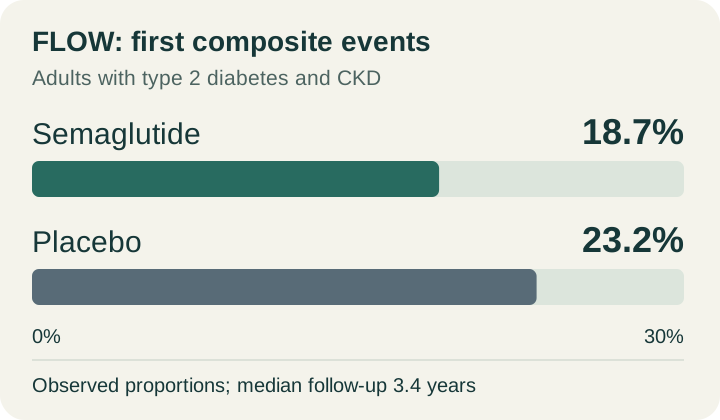
The headline “24% lower risk” is a relative comparison. The trial recorded 331 first primary-outcome events among 1,767 participants assigned semaglutide and 410 among 1,766 assigned placebo. Those event counts help readers interpret the relative hazard ratio without treating it as a claim that 24% of all patients will personally avoid kidney disease progression.
| Trial group | First events / participants | Observed proportion |
|---|---|---|
| Semaglutide | 331 / 1,767 | 18.7% |
| Placebo | 410 / 1,766 | 23.2% |
The crude difference is about 4.5 percentage points. It should not be turned into a personal prognosis or a fixed-time number needed to treat. A composite result also cannot establish the effect on each component separately.
What did the safety results show?
Serious adverse events affected 877 participants (49.6%) with semaglutide and 950 (53.8%) with placebo. However, adverse events leading to permanent treatment discontinuation were more frequent with semaglutide: 233 (13.2%) versus 211 (11.9%). Overall serious-event totals therefore do not establish that treatment has no important harms. See the primary paper, Table 3.
What changed in Australia?
The Therapeutic Goods Administration records that Ozempic (semaglutide) received an additional Australian indication on 18 August 2025. The registered indication states that Ozempic is also indicated, as an adjunct to standard-of-care therapy, to reduce the risk of sustained decline in kidney function and cardiovascular death in adults with type 2 diabetes and CKD.
That regulatory decision is distinct from PBS subsidy, prescribing suitability and individual treatment decisions. Registration of an indication does not mean every person with CKD is an appropriate candidate, and FLOW did not study a general CKD population without type 2 diabetes.
FLOW versus broader GLP-1 evidence
| Question | What the evidence supports | What it does not establish |
|---|---|---|
| Does semaglutide have dedicated kidney-outcomes evidence? | Yes. FLOW prospectively tested a kidney-focused composite outcome in type 2 diabetes with CKD. | It does not establish the same benefit in every CKD population. |
| Was the result only an eGFR surrogate? | No. The primary composite included kidney failure, sustained major eGFR loss and kidney/CV death. | The composite should not be reduced to a single component. |
| Is this just a weight-loss trial? | No. FLOW was a dedicated CKD outcomes trial. | Its kidney result should not be inferred solely from weight change. |
| Is the Australian indication current? | Yes. The TGA registration page records the additional indication from 18 August 2025. | TGA registration is not the same as PBS subsidy or individualized medical advice. |
Does FLOW prove extra benefit alongside an SGLT2 inhibitor?
A prespecified analysis separated the 550 participants using an SGLT2 inhibitor at baseline from the 2,983 who were not. In the smaller subgroup, the primary-outcome estimate was imprecise: hazard ratio 1.07 (95% CI 0.69–1.67). The interaction test did not detect a difference between subgroups (P=0.109), but low statistical power limits that conclusion. It proves neither an absence of benefit nor a precise additional benefit from the combination. Baseline SGLT2 use was not randomly assigned. Read the 2024 FLOW SGLT2 analysis.
What does the 2026 follow-up add?
A 2026 analysis examined the same FLOW participants by kidney-function and urine-albumin categories. It adds detail about the original population, rather than results from a new independent randomized trial. The kidney subgroups were prespecified, but were not powered for definitive subgroup conclusions. Analyses of all-cause death by CKD severity were post hoc and exploratory. The authors also identify limited representation: participants were mostly older, male and White. These qualifications matter when considering how widely results apply. Read Tuttle and colleagues’ 2026 CKD-severity analysis.
Important evidence limits
FLOW was stopped early after a prespecified interim analysis showed efficacy, and its population was deliberately defined: adults with type 2 diabetes and CKD meeting trial kidney-function and albuminuria criteria. The result therefore has strong relevance to that population but should not be extrapolated automatically to people with earlier kidney disease, CKD without diabetes, or people seeking weight-loss treatment without CKD.
The trial was sponsored by Novo Nordisk, the manufacturer of semaglutide. The primary result was published in a peer-reviewed journal and the trial record is available through ClinicalTrials.gov, allowing the design, population and outcomes to be checked independently of promotional summaries.
Related evidence guides
- GLP-1 foundations: the hormone, receptor and medicines.
- How to read drug trials: comparators, endpoints and uncertainty.
- Australian GLP-1 regulation: TGA registration and PBS subsidy.
Primary sources
- Perkovic V, et al. Effects of Semaglutide on Chronic Kidney Disease in Patients with Type 2 Diabetes. New England Journal of Medicine (2024).
- ClinicalTrials.gov: FLOW, NCT03819153.
- Therapeutic Goods Administration: Ozempic additional CKD indication, registered 18 August 2025.
- Mann JFE, et al. FLOW analysis by baseline SGLT2 inhibitor use. Nature Medicine (2024). DOI: 10.1038/s41591-024-03133-0.
- Tuttle KR, et al. Kidney and Survival Outcomes with Semaglutide by CKD Severity in the FLOW Trial. CJASN (2026). DOI: 10.2215/CJN.0000000974.
This article is an evidence explainer, not medical advice. It does not provide dosing, preparation or acquisition guidance.
How to cite this article
Semaglutide and Kidney Disease: What the FLOW Trial Shows. Elite Peps Australia. Published 25 October 2026; updated 25 October 2026. https://elitepepsaustralia.com/semaglutide-kidney-disease-flow-trial-australia/
Source checks: Consult the primary studies, trial records and regulator documents linked in this article for current evidence and status. Publication and update dates do not by themselves indicate an evidence review.